PTE 2020-02 Section II(d)
The PTE 2020-02 annual retrospective review, done in an afternoon.
Calendar-year firms owe the written report and the senior executive certification by June 30. The workbook walks a compliance officer from the population to a locked report.
What the rule requires
- An annual review reasonably designed to detect and prevent violations and to achieve compliance with the Impartial Conduct Standards.
- A written report to a Senior Executive Officer that explains the methodology and the results.
- A certification that the officer reviewed the report, that policies are prudently designed to achieve compliance, and that the firm has a prudent process to modify those policies and to test them.
- A deadline within six months after the period ends.
- A six-year file of the report, the certification, and the supporting data, available to the Department of Labor or the IRS within ten business days.
This is a description of the operative exemption, not legal advice. The 2024 Retirement Security Rule was vacated. PTE 2020-02, including Section II(d), was republished and remains in effect.
How the workbook walks you through it
1. Set the review period
Enter the period. The due date is six months after it ends. For a calendar year, that is June 30.
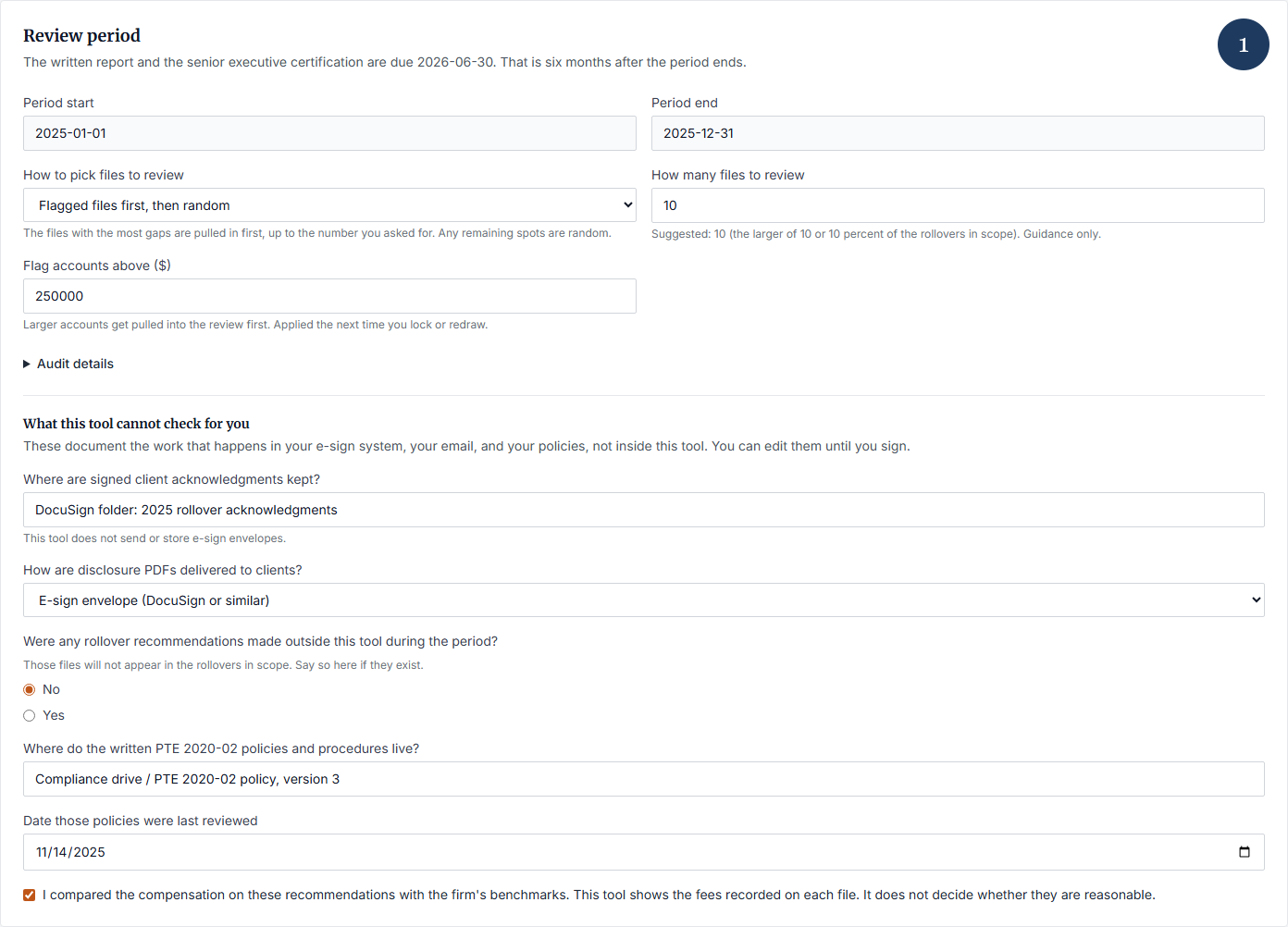
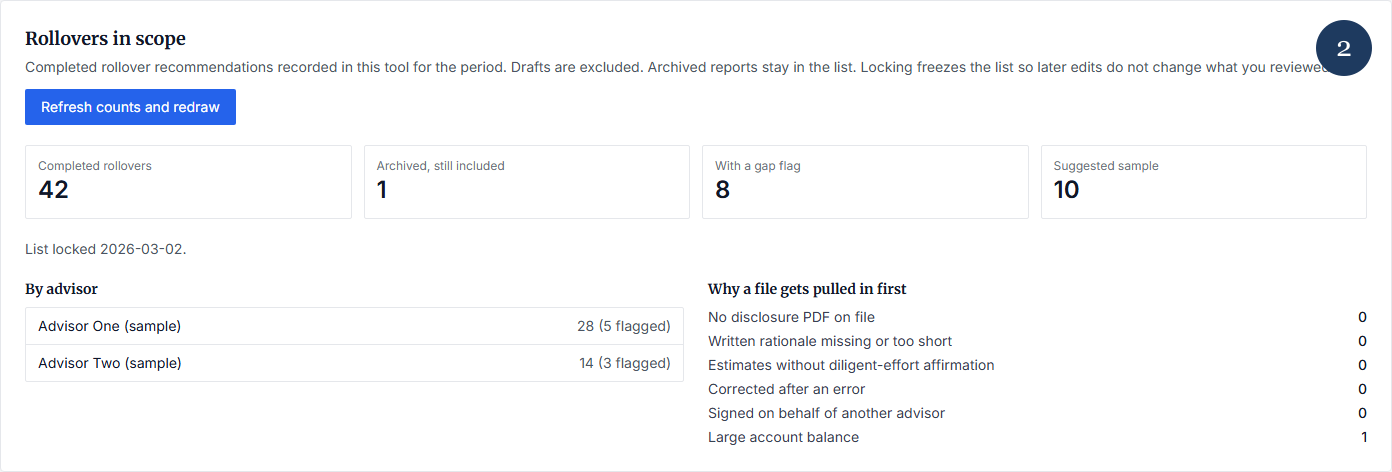
2. Lock the rollovers in scope
The list is the completed rollover recommendations recorded in the tool. Locking it freezes what you reviewed.
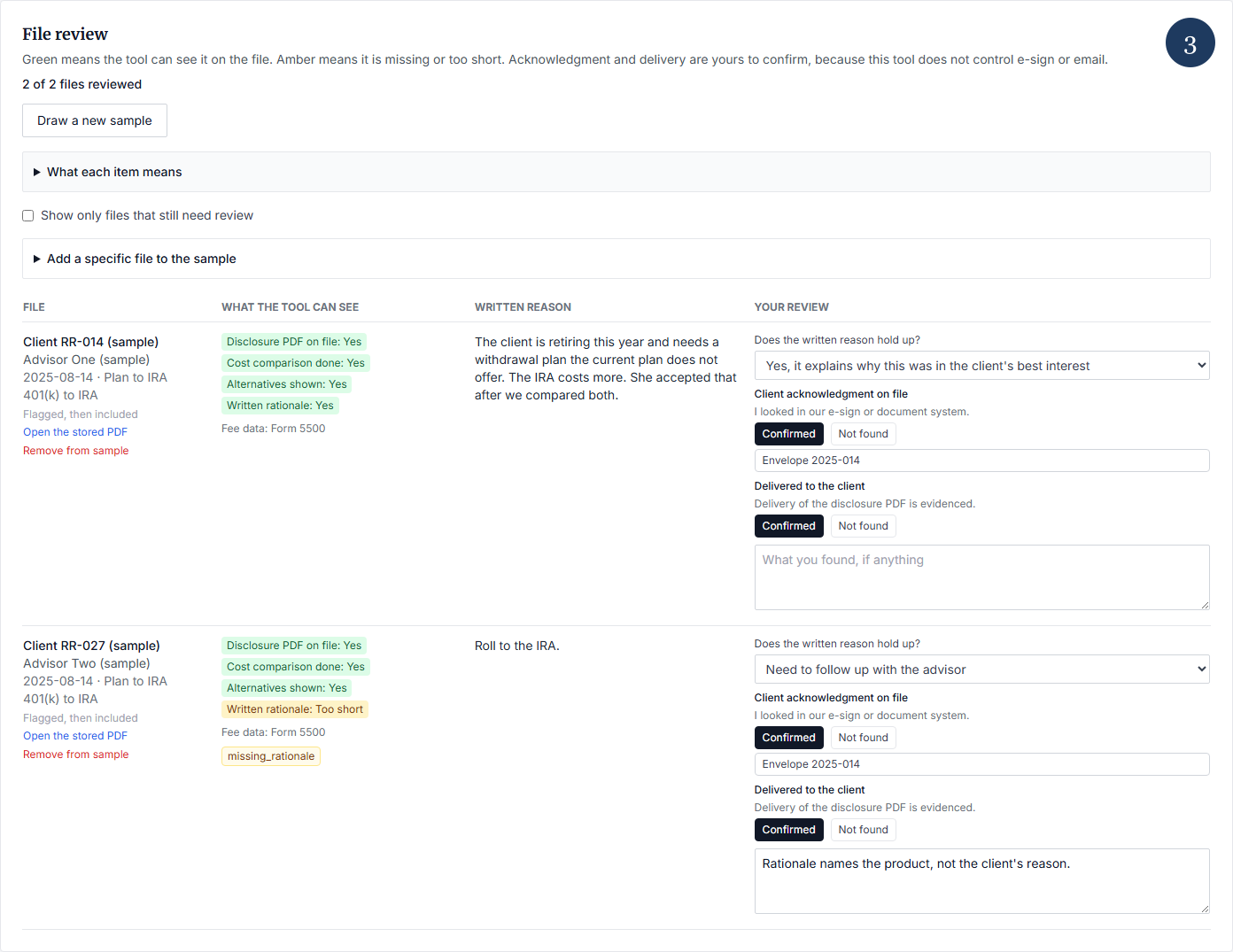
3. Test the sample
Draw a sample, then rate the written reason and confirm the items the file cannot prove.
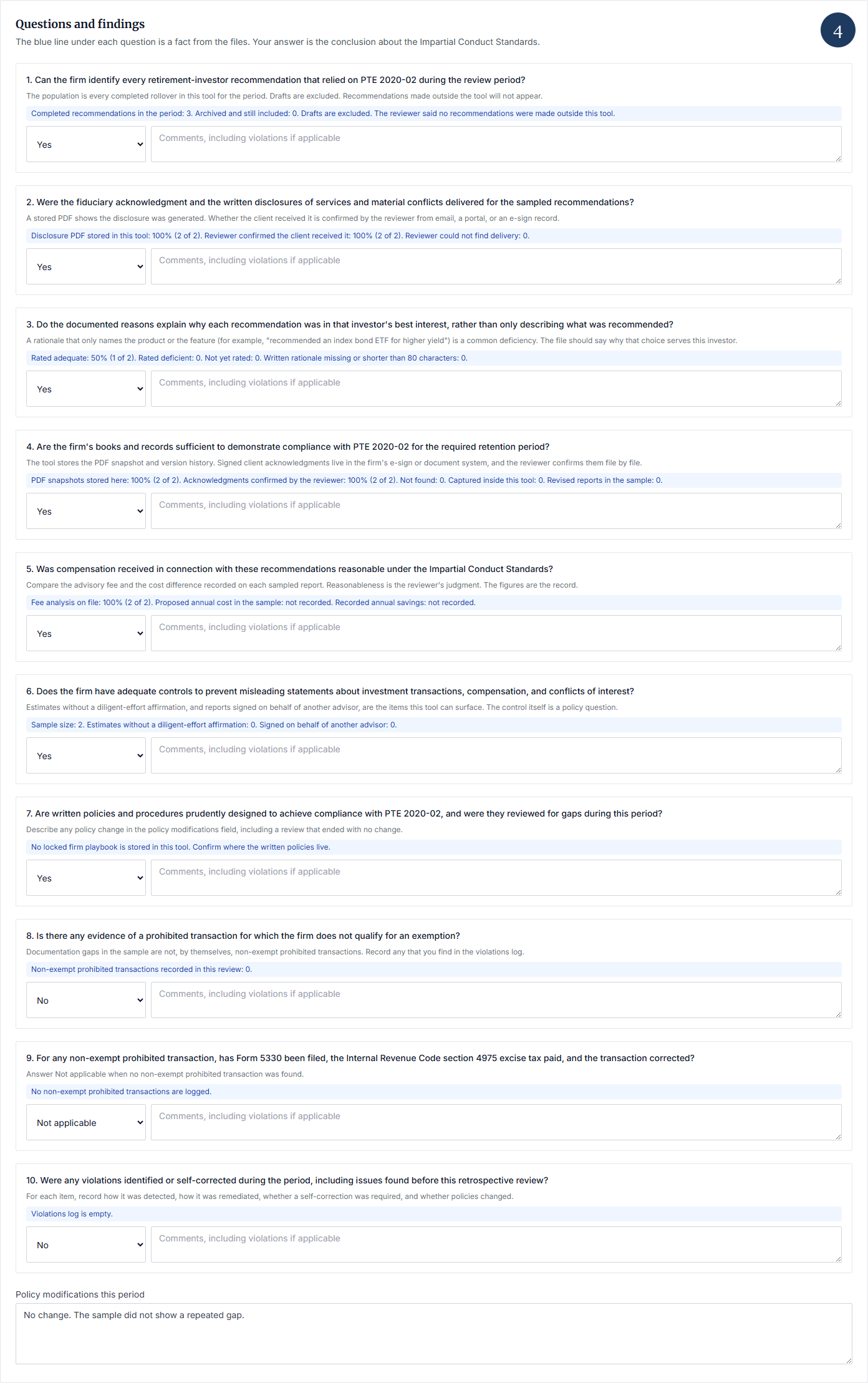
4. Answer the review questions
The questions cover disclosures, compensation, policies, and any violation you found.
5. Certify and lock the report
A senior executive reviews the written report and certifies. Signing locks the review.
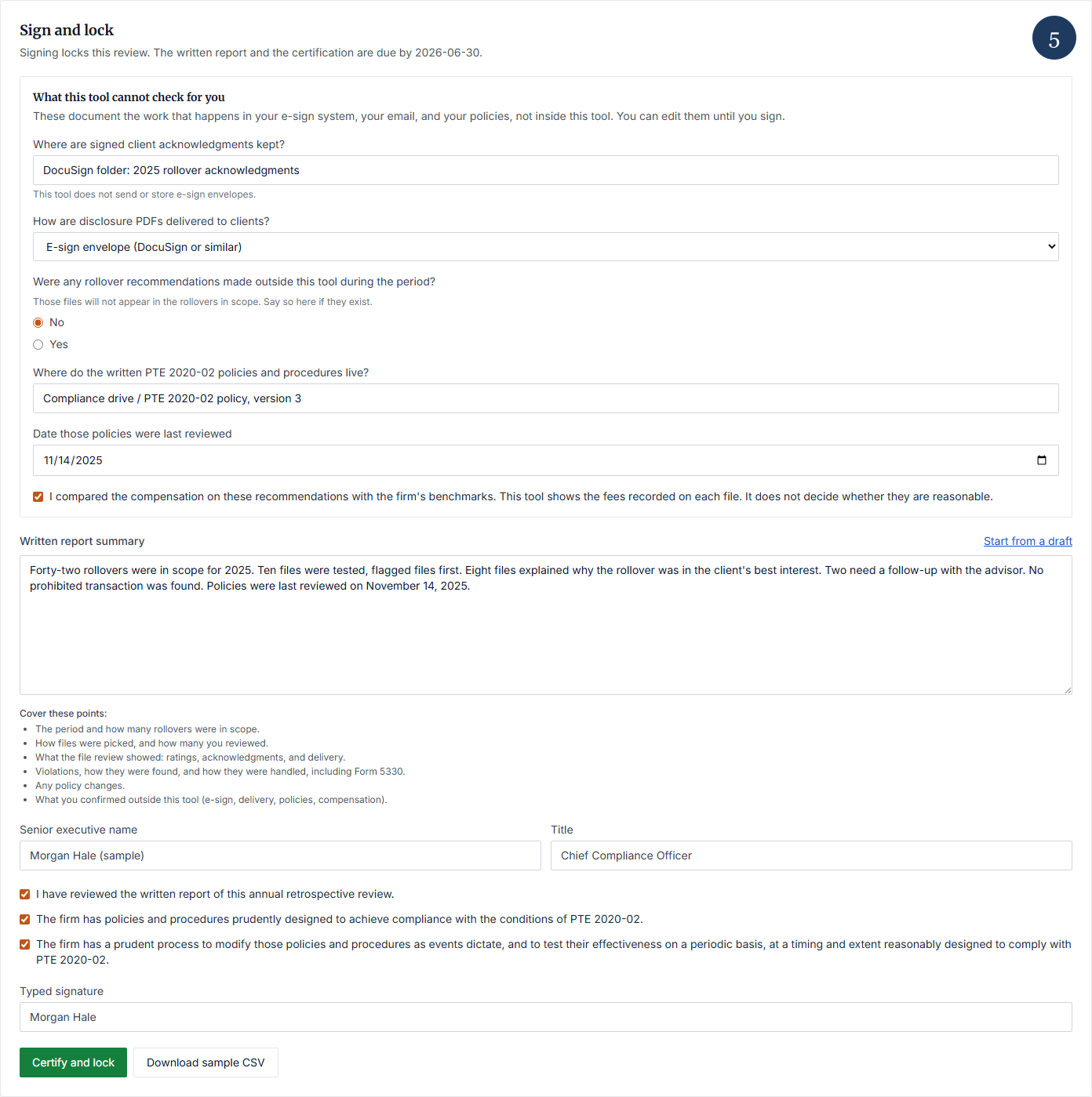
A short walkthrough
What the tool verifies and what you confirm
A stored PDF is not the same thing as a signed acknowledgment. The workbook keeps those apart so the written report does not claim more than the file can prove.
The tool can see
Disclosure PDF on file
The tool checks for a PDF snapshot of the completed version. That PDF includes the fiduciary acknowledgment, the services offered, material conflicts, and the options summary. A stored PDF does not prove the client received it.
Cost comparison done
The tool looks for both cost figures on the completed analysis.
Alternatives shown
Shown when a cost comparison or a disclosure PDF is on file. The options summary in the PDF covers staying in the plan, rolling to an IRA, and cashing out.
Written rationale
The tool reads the best-interest rationale on the analysis. Older files fall back to additional notes. Fewer than 80 characters counts as too short.
You confirm outside the tool
Client acknowledgment on file
This tool does not send or store DocuSign or other e-sign envelopes. You confirm this from your own records.
Delivered to the client
Delivery happens by email, a portal, or an e-sign envelope. The tool only knows the PDF was generated and stored.
Start with the planner
The PTE 2020-02 Annual Retrospective Review Planner is a spreadsheet for the timeline, the rollovers in scope, the sample, the file review, violations, and the written report. It is free. We email the link.
Questions
- When is the PTE 2020-02 retrospective review due?
- Section II(d) says the review, the written report, and the senior executive certification are due within six months after the end of the period. A firm that uses the calendar year owes them by June 30.
- Who can sign the certification?
- A Senior Executive Officer. The certification says they reviewed the report, the firm has policies prudently designed to achieve compliance, and the firm has a prudent process to modify those policies and to test them.
- How many rollover files should we test?
- The exemption does not set a sample size. A practical starting point is the larger of 10 files or 10 percent of the rollovers in scope, with flagged files pulled in first. Record the method and a seed so the draw can be repeated.
- What can the tool verify, and what can it not?
- The tool can see the stored disclosure PDF, the cost comparison, the alternatives, and the written rationale. It cannot see a signed acknowledgment in your e-sign system, proof of delivery, or whether compensation was reasonable against your own benchmarks. You confirm those.
- Is the free planner the same as the workbook?
- The planner is a spreadsheet you fill in by hand. The workbook in the tool pulls the population from completed rollovers, draws the sample, and locks the written report when the senior executive certifies.
- Which plans include the retrospective review?
- Every plan, including a free account with two reports. A solo advisor reviews their own rollovers and certifies the report. On a Firm plan, the manager runs one review across the whole team.